


This summer we received exciting news from our Partners at the Small Wild Cat Conservation Foundation (SWCCF)—after years of searching, a living African Golden Cat had finally been recorded in Angola. It’s an important breakthrough for a species that is still poorly understood, and will help guide future efforts to protect them.
If you’ve never heard of an African golden cat before, you are not alone. Close relatives of the better-known caracal and serval, these secretive wild cats live deep in the rainforests of West and Central Africa. They are notoriously reclusive, which has made the species one of the most difficult small cats in the world to study, let alone protect.
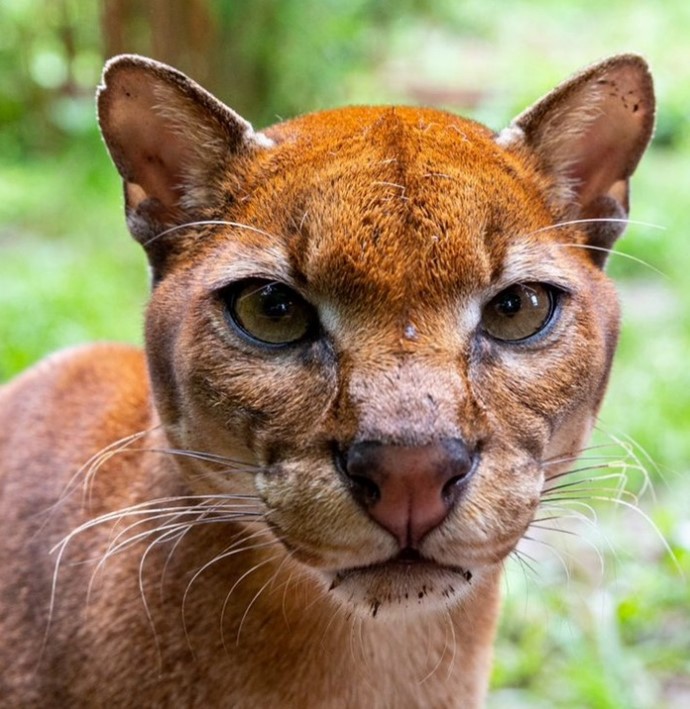
Nowhere was that mystery more pronounced than in Angola. In 1860, naturalist Philip Lutley Sclater documented a single golden cat skin obtained from an ivory caravan traveling through the country’s interior—evidence that the species existed there, but nothing more. Over the next 162 years only a few more skins would appear. More recently, a molecular study would help researchers identify a single sample of golden cat meat being sold in a market. But despite this proof that at least a few animals were present, no one was able to capture a photograph of a living golden cat in Angola.
That changed thanks to the work of Eduardo Lutondo and his team, working in partnership with the African Golden Cat Conservation Alliance (AGCCA) and Fundação Kissama. Lutondo, along with his teammates Timoteo Julio and Graça Catuti, spent three years searching for direct evidence of a living cat. They began in Maiombe National Park, prompted by a report from a nearby province. But months of monitoring with camera traps turned out to be fruitless.
The team’s breakthrough came from local knowledge. In 2024, community members shared information about a suspected African golden cat sighting in the Uíge region, in northwest Angola. Acting on this intelligence, the team deployed twelve trail cameras at Serra do Vampa—one of the mountains in the Serra do Pingano range which was recently designated as a protected area. After 144 days Eduardo retrieved the footage and found what his team had spent years searching for: the first video ever recorded of a living African golden cat in Angola.
The discovery is more than a historic first. It confirms that a population of the species still survives in the region, even as hunting continues to pose a direct threat to its future there. With this evidence in hand, Eduardo and his colleagues are now working to expand their community-led conservation efforts, aiming to reduce hunting pressure and build local support for protecting the species.
The project was supported by the SWCCF, and builds on AGCCA’s broader work uniting conservationists across the African golden cat’s range. Jim Sanderson, founder and director of the SWCCF, often notes that protecting a species this elusive takes passion, patience, and persistence. And that is exactly what yielded this incredible finding.
Small wild cats receive less than 1% of the conservation funding given to their larger cousins. If you would like to support the effort to save incredible species like the African golden cat, please consider donating below.